

Yogesh Courier Tracking: Monitor Your Parcel’s Journey with Live Updates
Yogesh Courier Services provides instant shipment visibility through an advanced tracking platform that delivers precise location data, transit milestones, and delivery confirmations. Customers access complete consignment information by entering their unique identification code, receiving immediate updates on package whereabouts, estimated arrival windows, and handling status across the entire logistics chain from origin to final destination point.
How to Use Our Tracking Tool
The yogesh courier tracking interface features a simplified query mechanism requiring minimal input for maximum information output. Upon booking a shipment with Yogesh Courier, customers receive a distinctive alphanumeric identifier printed on collection receipts and transmitted via SMS or email confirmation. This code functions as the digital key unlocking all movement records associated with that specific parcel.
Access the tracking search panel by navigating to the designated tracking section. Input your identification code exactly as provided, without introducing additional characters, punctuation, or spacing. The system automatically recognizes multiple format variations including those with or without prefixes. Execute the search by selecting the track option, triggering an instantaneous database query.
Results appear within moments, presenting a multi-layered information dashboard. The primary display showcases current shipment position, most recent scanning activity, projected delivery date, and real-time status classification. Beneath this summary, users find chronological movement logs documenting every checkpoint the package traversed, complete with facility names, geographic locations, processing timestamps, and operational actions performed.
Advanced functionality permits simultaneous tracking of multiple consignments through bulk search capabilities. Enter several tracking codes in sequence, separated by line breaks or comma delimiters, to generate consolidated reports showing parallel shipment progressions. This feature proves invaluable for commercial clients managing fleet deliveries or individuals monitoring numerous parcels concurrently.
Decoding Shipment Status Messages
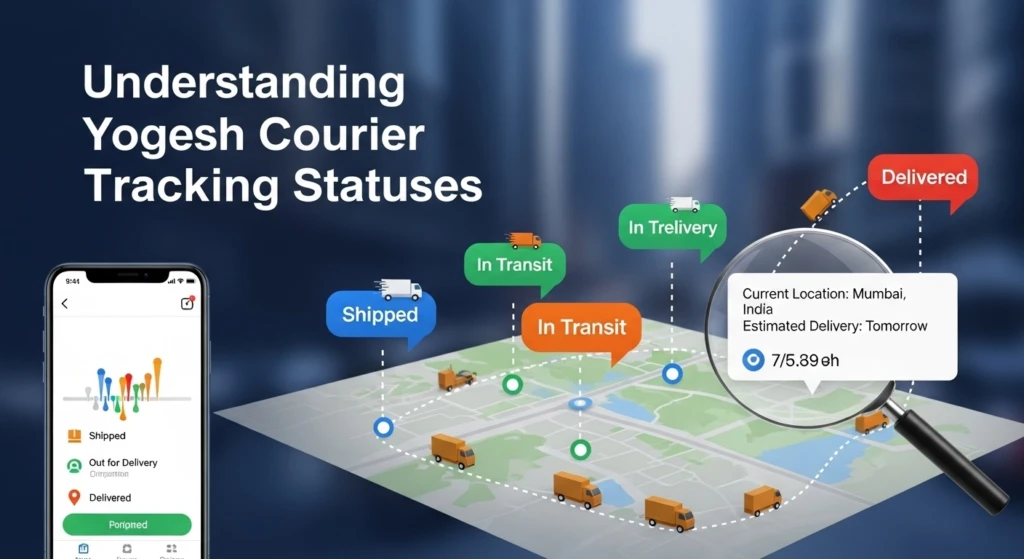
Yogesh Courier employs standardized status terminology reflecting precise operational stages within the delivery pipeline. “Consignment Registered” signifies initial system entry following booking acceptance and identifier allocation. “Pickup Completed” confirms physical collection from sender premises, marking the commencement of active transportation.
“Forwarded to Hub” indicates dispatch from local collection points toward regional consolidation centers where parcels undergo sorting and routing assignments. “Hub Processing” reflects intermediate handling at major transit facilities including scanning, categorization, and preparation for onward movement. “Dispatched from Hub” confirms departure toward the next destination point within the network.
“Reached Delivery Center” signals arrival at the final-mile facility serving the recipient’s geographic area, typically occurring one business day before attempted delivery. “Assigned to Delivery Executive” means a field agent has received the package for transport to the destination address. “Delivery in Progress” indicates active movement toward the recipient location during the final delivery run.
“Successfully Delivered” provides delivery completion confirmation including recipient signature details, handover timestamp, and acceptor identification. Alternate status messages include “Delivery Attempted – Recipient Unavailable” when access proves impossible, “Held at Branch – Awaiting Instructions” for packages requiring additional directives, and “Customs Processing” for international shipments undergoing regulatory clearance procedures.
Service Speed and Delivery Commitments
Yogesh Courier operates differentiated service categories aligned with varying urgency requirements and budget considerations. Within major urban centers encompassing Mumbai, Delhi NCR, Bangalore, Chennai, Hyderabad, Pune, and Ahmedabad, premium express services guarantee 24-hour delivery for bookings completed before noon cutoff times. Standard metropolitan service completes within 2-3 business days.
Intercity connections between Tier-1 and Tier-2 urban areas typically require 3-5 business days under regular service parameters. Deliveries extending to smaller cities, district headquarters, and semi-urban locations generally complete within 5-7 business days. Remote rural addresses, island territories, and difficult-access regions may necessitate 8-12 business days depending on transportation frequency and terrain challenges.
Economy service options provide cost-effective alternatives with extended timelines of 7-10 business days for most domestic destinations. Time-critical services including same-day delivery operate within select metropolitan zones for urgent document and small parcel requirements, subject to weight restrictions and distance limitations typically capped at 25 kilometers from booking locations.
| Destination Type | Express Service | Standard Service | Economy Service |
|---|---|---|---|
| Metro to Metro | 24-48 hours | 2-4 days | 5-7 days |
| Metro to Tier-2 | 2-3 days | 4-6 days | 7-9 days |
| Tier-2 to Tier-2 | 3-4 days | 5-7 days | 8-10 days |
| Urban to Rural | 4-6 days | 7-10 days | 10-14 days |
Seasonal variations affect delivery performance during peak periods including festival seasons, year-end holiday rushes, and major sale events when shipment volumes surge significantly. Adverse weather conditions particularly monsoon flooding in coastal regions and winter fog in northern plains occasionally introduce delays of 1-3 additional days beyond published timelines.
Troubleshooting Tracking Challenges
Initial tracking unavailability within 12-24 hours following booking constitutes normal operational lag time. System registration requires completion of multiple backend processes including manifest generation, route planning, barcode printing, and initial facility intake scanning. Shipments collected during evening hours or weekends may not reflect tracking data until the subsequent business day when sorting operations commence.
Prolonged status stagnation at specific locations warrants investigation after three business days without progression. Common causes include consolidation delays where facilities accumulate sufficient volume before dispatching consolidated loads, missed scanning during transfer operations, or packages set aside for special handling requirements. Direct customer service contact enables manual intervention through warehouse personnel who can physically locate consignments and provide verbal status updates.
Premature delivery status updates marking packages as “delivered” when recipients confirm non-receipt require immediate escalation. First verify with all household occupants, workplace reception staff, neighboring addresses, and building security teams who might have accepted packages during recipient absence. Yogesh delivery personnel occasionally release parcels to responsible parties at the delivery address when primary recipients remain unreachable. Confirmed delivery discrepancies necessitate formal complaint filing within 48 hours for investigation initiation and potential claim processing.
Address-related delivery failures emerge as the predominant obstacle preventing successful handovers. Tracking systems flag these situations with messages like “incomplete address details” or “location not accessible.” Immediate remediation requires contacting support services to supply comprehensive address corrections including precise building identifiers, floor specifications, nearby landmarks, alternative contact numbers, and detailed location descriptions. Prompt correction prevents automatic return-to-sender protocols that add 7-10 days to resolution cycles.
Technology infrastructure limitations in remote locations occasionally create synchronization gaps between physical package movement and digital tracking updates. Packages may progress through multiple checkpoints or reach final delivery while tracking displays outdated information. Updates materialize when field personnel return to connectivity zones and upload accumulated scan data, sometimes producing abrupt status transitions spanning multiple stages simultaneously.
Geographic Reach and Infrastructure
Yogesh Courier maintains operational presence across 28 Indian states and 8 union territories, servicing approximately 2,200 cities, towns, and semi-urban settlements. The network architecture comprises 85 regional distribution hubs, 320 city-level processing centers, and over 1,500 delivery zones ensuring comprehensive coverage across diverse geographic terrains.
Northern operations concentrate on dense urban corridors including Delhi NCR, Punjab, Haryana, Uttar Pradesh, and Rajasthan, handling high-volume document and parcel movements between commercial centers. Southern network strength focuses on technology corridors connecting Bangalore, Chennai, and Hyderabad with extensive last-mile penetration into Kerala, Tamil Nadu, Karnataka, and Andhra Pradesh markets.
Western region coverage emphasizes Maharashtra and Gujarat industrial belts with specialized handling capabilities for textile, pharmaceutical, and manufacturing sector shipments. Eastern operations serve West Bengal, Odisha, Bihar, and northeastern states through strategically positioned hubs in Kolkata and Guwahati managing complex terrain and infrastructure challenges unique to these regions.
Specialized service verticals include temperature-controlled logistics for pharmaceutical and perishable goods, high-security transport for valuable items and sensitive documents, oversized cargo handling for industrial equipment and machinery parts, and reverse logistics supporting e-commerce return management. Dedicated fleet segments operate for different cargo categories including two-wheelers for urgent documents, light commercial vehicles for standard parcels, and heavy goods vehicles for bulk shipments.
Contact Information and Support Channels
| City | Contact Numbers | Email Address | Office Address |
|---|---|---|---|
| Mumbai | +91-22-28745600 | mumbai@yogeshcourier.co.in | Yogesh Courier Services, Dadar East, Mumbai, Maharashtra 400014 |
| Delhi | +91-11-45673200 | delhi@yogeshcourier.co.in | Yogesh Courier Services, Lajpat Nagar, New Delhi, Delhi 110024 |
| Bangalore | +91-80-42897300 | bangalore@yogeshcourier.co.in | Yogesh Courier Services, Indiranagar, Bangalore, Karnataka 560038 |
| Chennai | +91-44-29568700 | chennai@yogeshcourier.co.in | Yogesh Courier Services, Vadapalani, Chennai, Tamil Nadu 600026 |
| Hyderabad | +91-40-28963400 | hyderabad@yogeshcourier.co.in | Yogesh Courier Services, Kukatpally, Hyderabad, Telangana 500072 |
| Pune | +91-20-27854900 | pune@yogeshcourier.co.in | Yogesh Courier Services, Kothrud, Pune, Maharashtra 411038 |
| Kolkata | +91-33-25894600 | kolkata@yogeshcourier.co.in | Yogesh Courier Services, Salt Lake, Kolkata, West Bengal 700064 |
| Ahmedabad | +91-79-27965800 | ahmedabad@yogeshcourier.co.in | Yogesh Courier Services, Satellite, Ahmedabad, Gujarat 380015 |
FAQs
How frequently does Yogesh Courier update tracking information?
Yogesh Courier tracking updates occur in real-time as packages pass through scanning checkpoints throughout the delivery network. Major facilities including origin hubs, transit centers, and destination branches perform automatic scans during intake, sorting, and dispatch operations. Field delivery personnel equipped with handheld scanning devices update status during pickup and delivery events. Update frequency varies by location connectivity, with urban facilities providing near-instantaneous synchronization while remote areas may batch updates when connectivity permits. Standard shipments receive minimum 4-6 scanning events during typical intercity transit including collection confirmation, origin hub processing, destination hub arrival, delivery assignment, and final handover completion.
What happens if tracking shows no movement for several days?
Shipments displaying static status beyond 72 business hours may be experiencing consolidation delays, scanning omissions, or special handling requirements. Yogesh Courier accumulates packages at regional hubs to optimize transport efficiency, occasionally holding consignments 2-4 days awaiting sufficient volume for economical long-distance dispatch. Alternatively, packages might have moved physically but missed intermediate scans due to equipment malfunctions or process gaps. Contact customer service providing your tracking identifier to trigger manual investigation. Support teams access warehouse management systems showing physical package locations independent of automated scanning records, enabling accurate status determination and estimated delivery projections even when tracking displays outdated information.
Can I modify delivery instructions after shipment dispatch?
Delivery instruction modifications remain possible with limitations based on current shipment location and requested changes. Simple additions like contact number updates, landmark descriptions, or delivery time preferences can be communicated to customer service at any transit stage. Address changes prove feasible only when packages remain within origin city facilities before intercity transportation commences. Once shipments enter long-distance transit or reach destination sorting centers, full address redirections become operationally impractical as routing and delivery assignments finalize. Alternative solutions include arranging branch pickup at the destination city location or scheduling redelivery attempts with updated instructions, both requestable through customer service channels without additional charges for standard modifications.
Why do some packages show delivered without my knowledge?
Premature or inaccurate delivery status updates occasionally result from several scenarios. Delivery personnel sometimes mark packages delivered upon departure for delivery runs rather than after actual handover, creating timing discrepancies of 2-6 hours. Packages delivered to building security, household staff, neighbors, or family members may not immediately reach intended recipients despite successful delivery completion. In rare instances, scanning errors or system glitches incorrectly update status. First verification involves thoroughly checking with all potential package recipients at the delivery address including security personnel, domestic help, adjacent apartments, and household members. Review tracking details showing delivery timestamp, recipient name if captured, and location specifics. If verification confirms non-receipt, immediate complaint filing initiates investigation protocols examining delivery agent records, GPS data if available, and facility surveillance footage to determine package fate and enable insurance claim processing if necessary.
How does tracking work for intercity versus intracity shipments?
Intercity shipments traverse multiple facility types creating more extensive tracking records than intracity movements. Long-distance packages generate scans at origin collection points, origin sorting hubs, potential intermediate transit hubs, destination city sorting centers, final delivery branches, and recipient handover points, producing 6-10 tracking events. Intracity shipments within single metropolitan areas may bypass intermediate hubs, moving directly from collection to local sorting to delivery, generating 3-5 scanning events total. Same-day intracity services often show minimal tracking granularity with only pickup confirmation and delivery completion due to rapid transit timelines limiting intermediate checkpoint passage. Tracking update frequency also differs, with intercity shipments potentially showing static status during overnight highway transport between cities, while intracity packages typically progress more visibly through same-day scanning cycles.
The tracking platform provides comprehensive shipment oversight enabling users to monitor package progression, verify current locations, and access support resources for addressing delivery concerns. Consistent tracking monitoring facilitates proactive issue identification and ensures recipients maintain accurate delivery expectations throughout the shipping cycle.